
Introduction
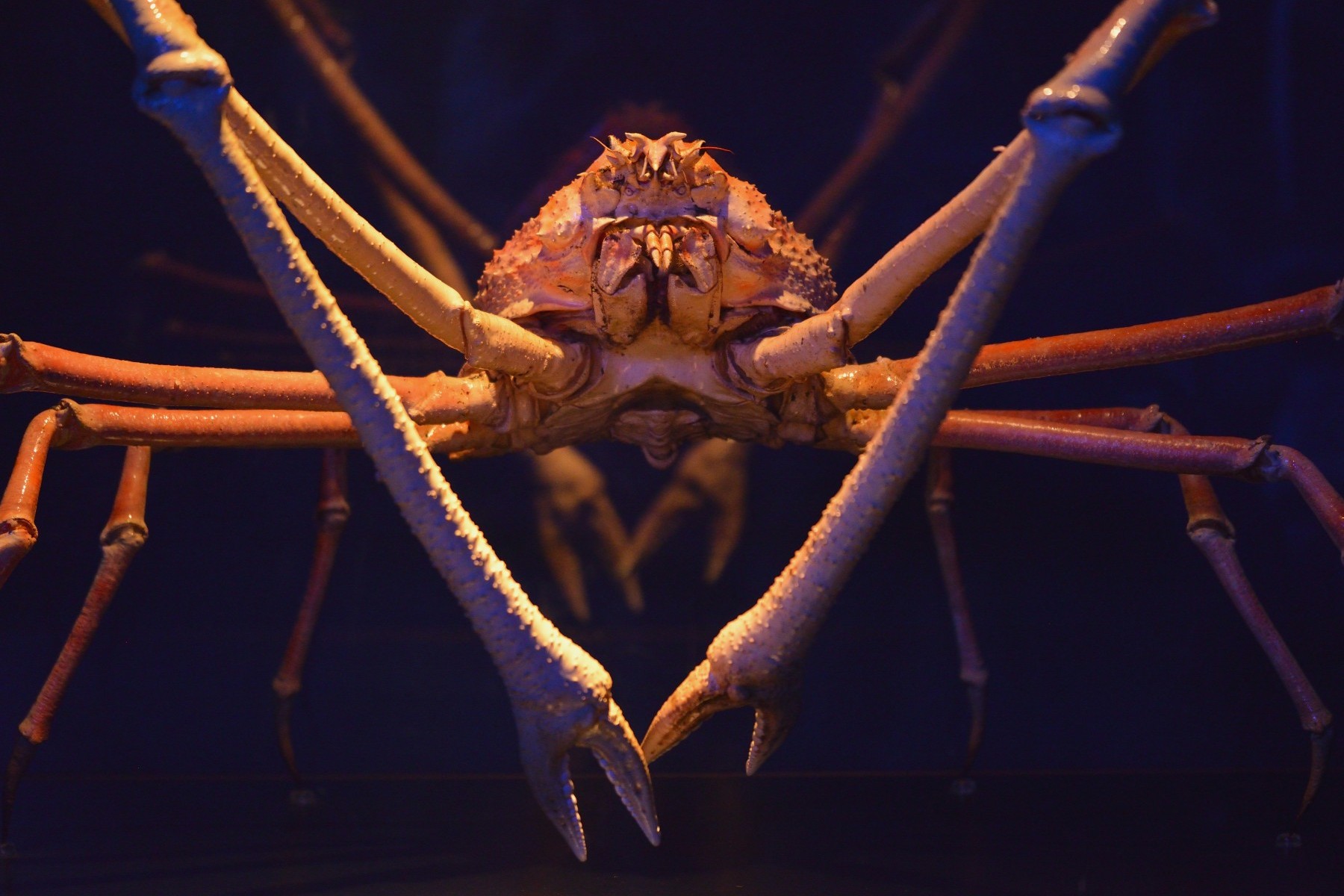
Macrocheira kaempferi, commonly known as Japanese Giant Spider Crab, is the largest living arthropod in the world. Its leg span can reach 3.7 meters and its weight exceed 13.6 kg.
It was first described in 1836 by Temminck, and long classified in the Majidae family, then the Inachidae. Recent studies on its larvae and DNA have shown that it deserves its own family, the Macrocheiridae, due to unique characteristics in the carapace, thoracic sternum, and genital organs.
Who is it?
Morphology
-
Average size300 cm
-
Maximum size370 cm
-
Average size300 cm
-
Maximum size370 cm
How to recognize this crustacea ?
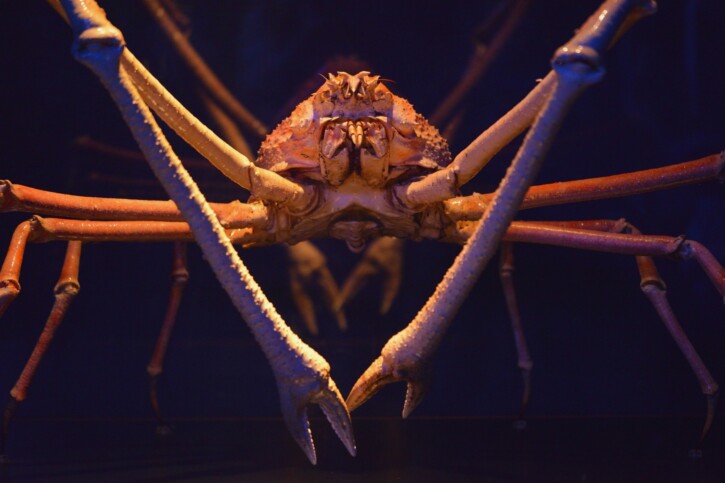
The silhouette is imposing, with a subcircular carapace covered in sharp tubercles, especially on the gill regions. The legs are extremely long and slender, with elongated claws in males. The coloration is speckled with reddish-orange dorsally, transitioning to a creamy white on the ventral side. After molting, individuals have more pronounced colors.
Sexual dimorphism
Males have elongated claws and a narrow abdomen, females have a wider abdomen. No other dimorphism is visible to the naked eye.
Behaviour & Life cycle
-
Sociabilityliving in a group or alone
-
territorialYes
-
VenomousNo
-
Way of livingdiurnal
Like all crustaceans, The Japanese Giant Spider Crab molts whenever it becomes cramped in its shell. Before the hardening of its new body, it is more vulnerable and spends a good part of its time hidden. This mechanism, very complex, allows the periodic renewal of the exoskeleton and part of the internal skeleton. It is also during the moult that the females become fertile.
This species is benthic, living on the seabed of deep seas. This crab is an opportunistic omnivore, feeding mainly on carrion, organic debris, algae, and small invertebrates. It does not seem to actively hunt live prey. Its long, slender claws are adapted for handling, tearing, and transporting food.
Reproduction
-
Reproductionovipare
-
Migratory speciesYes
This crab may migrate to shallower waters during the breeding season. Fertilization is internal and occurs during the female's molt. The female can produce over a million eggs.
Harmless species
The species is harmless to humans.
Origin and distribution

Geographic distribution & Conservation
Populations of Macrocheira kaempferi have not been assessed by the IUCN. This crab is found in deep waters, between 50 and over 500 meters, mainly on the Pacific slope of Japan, between the islands of Honshu and Kyushu. Populations have also been observed in the deep waters of Su-ao, Taiwan.
Conservation status of populations (IUCN)
Where to see this species?

What is its habitat?
Natural environment characteristics
-
Temperature7 - 16 °C
-
Depth50 - 500 m
-
EnvironmentFree benthic
Biotope presentation
This crab lives in deep-sea bottoms, often muddy or sandy, with low light. The water temperature is estimated to be between 7 °C and 16 °C. Vegetation is rare, but algae and corals may be present in shallower areas.


To go further


Sources & Contributions
Participation & Validation
The Fishipedia team and specialist contributors are committed to providing high-quality content. However, although the information comes from scientific sources or testimonials from specialists, the cards may contain inaccuracies.

Benoit Chartrer
Translation
Translation done with the valuable contribution of our translators, who make this information available to a wider audience. We sincerely thank them for their commitment.
Where to see this species?
Scientific partners



Species of the same family


