
Spotfin Butterflyfish
| Family | Chaetodontidae |
|---|---|
| Genus | Chaetodon |
| IUCN category (World) | LC |
Introduction
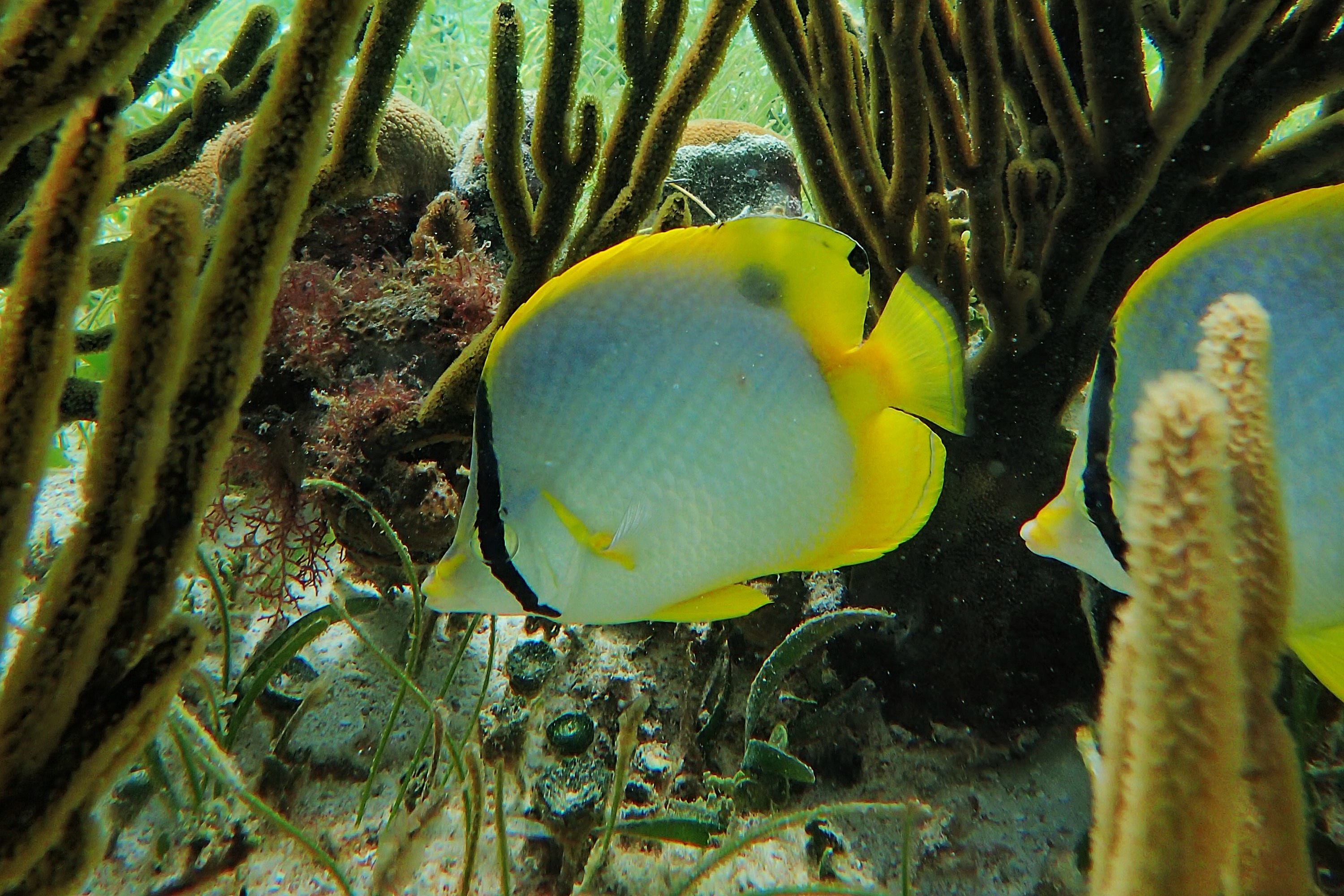
Chaetodon ocellatus, commonly known as Spotfin Butterflyfish, is a marine species native to the Caribbean region.
Who is it?
Morphology
-
Average size18 cm
-
Maximum size20 cm
-
ShapeCircular
-
Average size18 cm
-
Maximum size20 cm
-
ShapeCircular
How to recognize This fish ?
The body of the Spotfin Butterflyfish is short, deep, and strongly compressed laterally. Its white coloration is crossed by a wide black vertical bar covering the head and passing through the eye. A narrow yellow band connects the gill opening to the base of the pectoral fin.
In juveniles, a second black bar extends from the base of the soft dorsal fin to that of the anal fin. The dorsal, caudal, and anal fins are adorned with yellow or remain transparent. A behavioral peculiarity marks the diel cycle: the appearance of diffuse dark bands on the body during the night.
Behaviour & Life cycle
-
dietcarnivorous
-
Sociabilityliving as a couple
-
territorialNo
-
Way of livingdiurnal
This species forms stable pairs, a sociability that is particularly maintained during the breeding season. It operates in pairs within its habitat, strengthening bonds between partners for territory defense. Its diet consists of various benthic invertebrates that it picks from the seabed. It actively probes coral and rocky substrates to capture its prey, an activity that occupies a large part of its day.
Reproduction
-
Reproductionovipare qui pond en eau libre
Adults form distinct pairs for breeding, releasing their gametes into the open water. The pelagic eggs drift with the currents. Larvae develop early the characteristic auditory structures and swim bladder of the genus, with inflated horns appearing after the larval stage (tholichthys).
Harmless species
The species is harmless to humans. It has no venom, stinging spines, or aggressive behavior towards humans.
Origin and distribution
Geographic distribution & Conservation
Its distribution range extends from New England (USA) to Brazil, including the Gulf of Mexico and Bermuda. Larvae, carried northward by the Gulf Stream, sometimes reach the coasts of Massachusetts or even Nova Scotia in summer, but do not survive the winter in these cold waters. Although the species has undergone local extinctions on certain Brazilian coasts due to capture for the aquarium trade, its overall population faces no major threat and remains common.
Conservation status of populations (IUCN)
What is its habitat?
Natural environment characteristics
-
Temperature24 - 28 °C
-
Depth0 - 30 m
Biotope presentation
The Spotfin Butterflyfish inhabits coral reefs and shallow rocky bottoms, between the surface and 30 meters deep. It prefers the clear and warm waters of tropical and subtropical regions. Juveniles recruit to these same habitats after their pelagic larval phase. The species is resident in these structured environments, where it finds shelter and food, although individuals drifting out of tropical zones cannot establish themselves there permanently.


To go further
Species of the same family

long-nose butterflyfish
Chaetodontidae

Johnrandallia nigrirostris
Chaetodontidae

black long-nosed butterflyfish
Chaetodontidae

pennant coralfish
Chaetodontidae

brushytoothed butterflyfish
Chaetodontidae

red sea bannerfish
Chaetodontidae

copperband butterflyfish
Chaetodontidae

threeband pennantfish
Chaetodontidae
Espèces du même genre
To read on the web


Sources & Contributions
Participation & Validation
The Fishipedia team and specialist contributors are committed to providing high-quality content. However, although the information comes from scientific sources or testimonials from specialists, the cards may contain inaccuracies.

Benoit Chartrer
Translation
Translation done with the valuable contribution of our translators, who make this information available to a wider audience. We sincerely thank them for their commitment.
Scientific partners



Species of the same family
long-nose butterflyfish
Chaetodontidae
Johnrandallia nigrirostris
Chaetodontidae
black long-nosed butterflyfish
Chaetodontidae
pennant coralfish
Chaetodontidae
brushytoothed butterflyfish
Chaetodontidae
red sea bannerfish
Chaetodontidae
copperband butterflyfish
Chaetodontidae
threeband pennantfish
Chaetodontidae
Same genus


