
Buffalo Trunkfish
| Family | Ostraciidae |
|---|---|
| Genus | Lactophrys |
| IUCN category (World) | LC |
Introduction
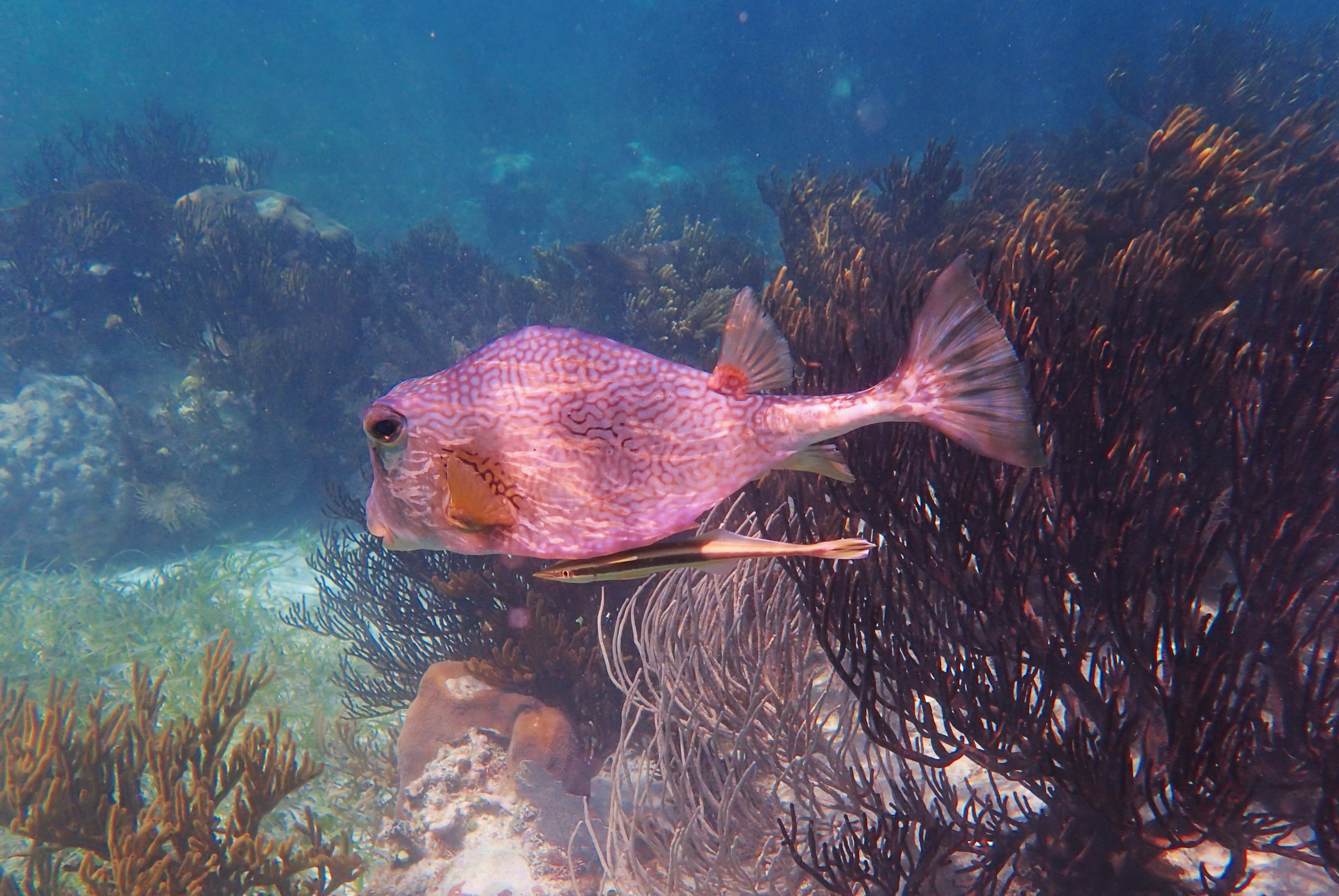
Lactophrys trigonus, commonly known as the Buffalo Trunkfish, is a marine species in the Ostraciidae family.
Its distribution extends in the Western Atlantic, from Canada (Nova Scotia) and Massachusetts (USA) to southern Brazil, including Bermuda, the Gulf of Mexico, and the Caribbean Sea. Sightings in the Mediterranean Sea exist but require confirmation, with no confirmed presence in the Eastern Atlantic.
This species is widely distributed and common in seagrass beds, coral reefs, or rocky habitats. Classified as Least Concern (LC) by the IUCN, it faces no major identified threats, although it is locally exploited as food fish in the Caribbean.
Who is it?
Morphology
-
Average size30 cm
-
Maximum size55 cm
-
Patternmultiple
-
Average size30 cm
-
Maximum size55 cm
-
Patternmultiple
How to recognize This fish ?
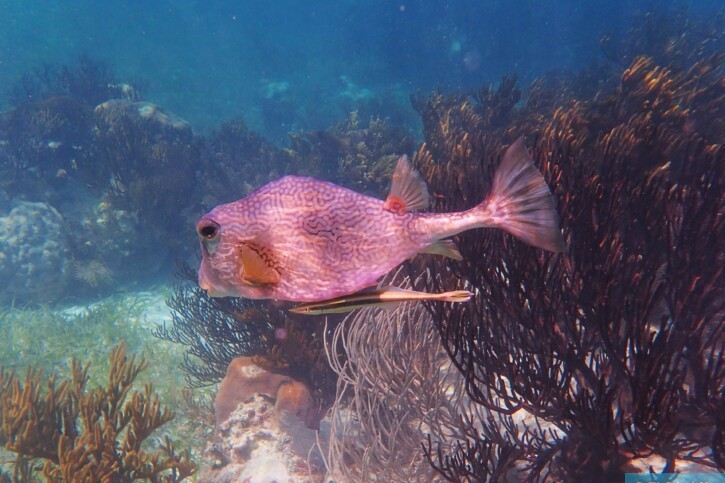
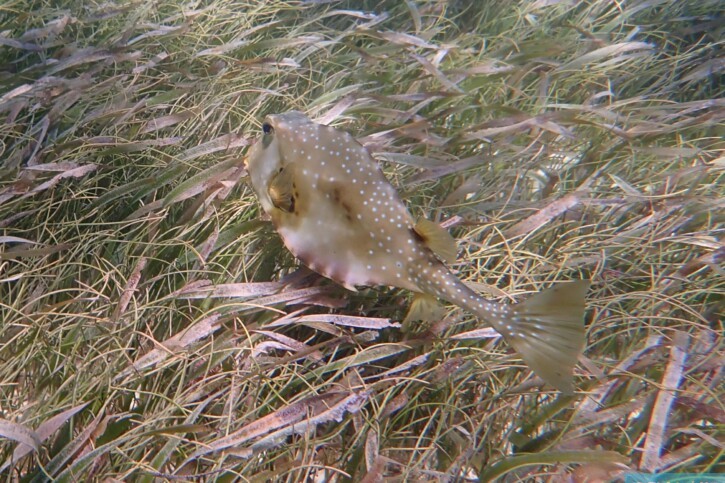
The silhouette of Lactophrys trigonus is short and deep, enclosed in a rigid bony carapace composed of fused hexagonal plates. This unique structure gives it a characteristic box shape. The coloration evolves with age: young individuals have a brownish background dotted with small diffuse white spots and adorned with two areas where the plates are bordered in black, forming chain-like patterns on the pectoral region and in the middle of the body. Larger specimens lose these light spots and chains to develop a dark and irregular reticulated pattern covering the entire carapace and caudal peduncle. The maximum observed size reaches 55 cm, with a recorded maximum weight of 3.3 kg, although the usual size is around 30 cm.
Sexual dimorphism
No external sexual dimorphism is visible in this species. Males and females share the same morphology, coloration, and size. Sex distinction is only possible by internal examination or during specific reproductive interactions.
Behaviour & Life cycle
-
dietomnivorous with carnivorous tendency
-
Sociabilitysolitary
-
territorialNo
-
Way of livingdiurnal
The behavior of Lactophrys trigonus is closely related to its rigid morphology. Unlike most fish that undulate to swim, this species uses its pectoral, dorsal, and anal fins to propel itself while keeping its body still. Its bony carapace plays a hydrodynamic role: it naturally generates buoyancy forces and controlled swirls along its ventro-lateral keels, allowing the fish to automatically correct pitch and yaw instabilities. This passive stability enables it to navigate with precision in the variable currents of its complex environment.
The species is active during the day, slowly sifting through the bottom in search of food. Its omnivorous diet is predominantly carnivorous, consisting of a wide variety of small benthic invertebrates such as mollusks, crustaceans, worms, sessile tunicates, and some seagrasses that it occasionally grazes on.
Reproduction
-
Reproductionovipare qui pond en eau libre
The Buffalo Trunkfish is oviparous. The eggs are pelagic and drift with the currents after spawning. Larvae develop in open water before metamorphosing and settling on the seafloor to adopt their characteristic benthic lifestyle. Specific data on seasonality or courtship rituals are not provided in the sources, but the species is known to form aggregations during reproduction in certain areas within its range.
Harmless species
The species poses a potential risk to humans if consumed because, like many Ostraciids, it can produce toxins (ostracitoxin) in its flesh, although it is considered a delicacy in some Caribbean regions where it is prepared with caution. Handled alive, it is harmless, as its rigid carapace protects it from predators without the need for active defense mechanisms like inflation.
Origin and distribution

Geographic distribution & Conservation
This fish resides in various coastal environments, from sheltered bays rich in vegetation to more exposed reef slopes. It tolerates a wide range of subtropical temperatures, from New England to Brazil. The structure of its habitat, particularly the density of seagrasses and reef complexity, directly influences its local distribution and abundance.
Conservation status of populations (IUCN)
What is its habitat?
Natural environment characteristics
-
Temperature23 - 26 °C
-
Depth2 - 50 m
Biotope presentation
Lactophrys trigonus inhabits seagrass beds, coral debris zones, and offshore reefs, down to a depth of 50 meters, although it is more common between 2 and 20 meters. It is absent from bare sandy areas without structure, preferring habitats that offer both food and potential shelter.


To go further



Sources & Contributions
Participation & Validation
The Fishipedia team and specialist contributors are committed to providing high-quality content. However, although the information comes from scientific sources or testimonials from specialists, the cards may contain inaccuracies.

Benoit Chartrer
Translation
Translation done with the valuable contribution of our translators, who make this information available to a wider audience. We sincerely thank them for their commitment.
Scientific partners



Tags
Species of the same family


