
Japanese rice fish
- Oryzias latipes latipes
- Oryzias latipes latipes
| Family | Adrianichthyidae |
|---|---|
| Genus | Oryzias |
| IUCN category (World) | LC |
Introduction
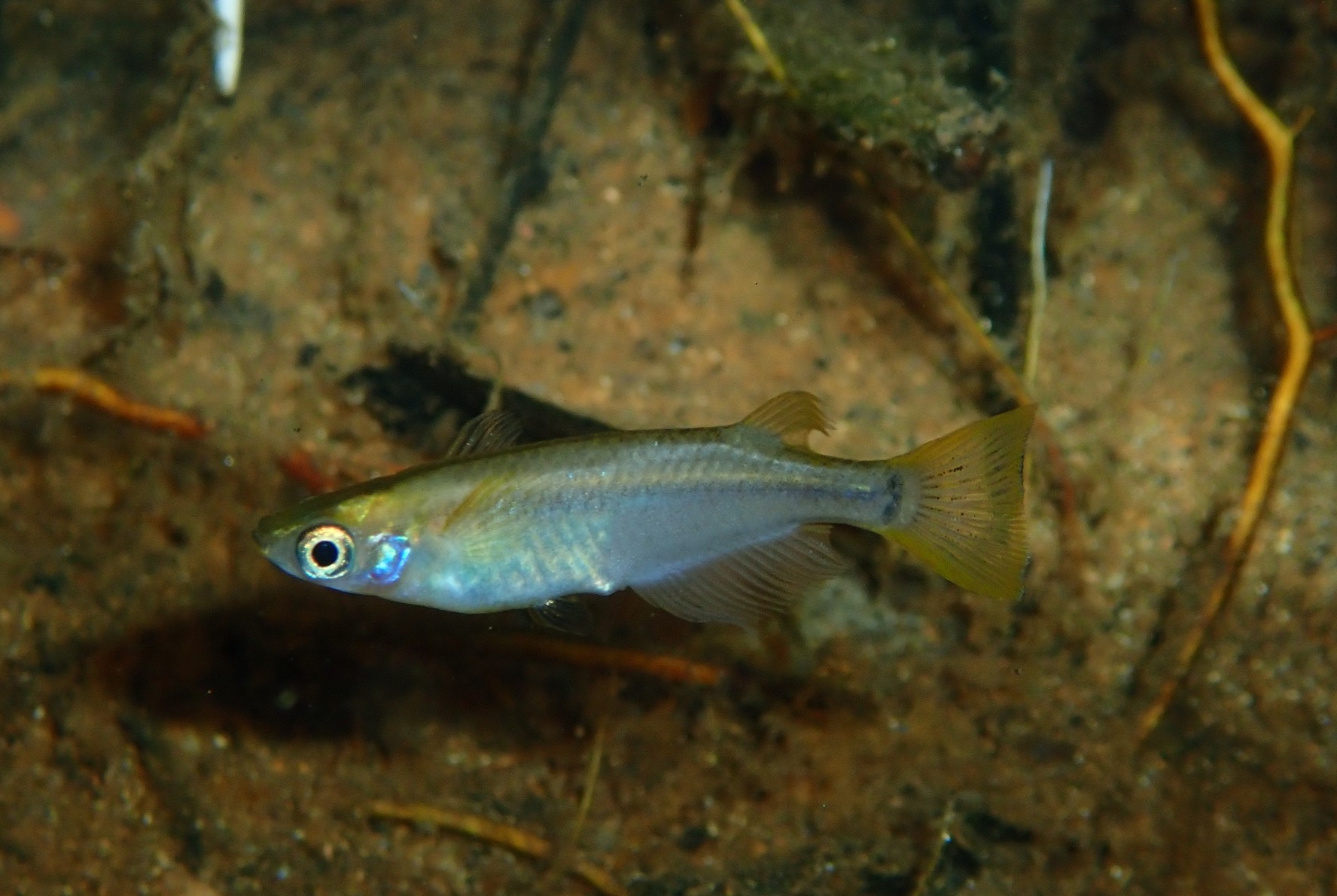
Oryzias latipes, commonly known as Japanese rice fish, is a small fish belonging to the Adrianichthyidae family. This species is endemic to the Japanese archipelago, where it has a wide distribution range extending from Honshu Island to the Ryukyu Islands, but is absent from the northern island of Hokkaido. Its generic name reflects its affinity for rice paddies, iconic habitats of its territory.
Who is it?
Morphology
-
Average size4 cm
-
Maximum size5 cm
-
Average size4 cm
-
Maximum size5 cm
How to recognize This fish ?
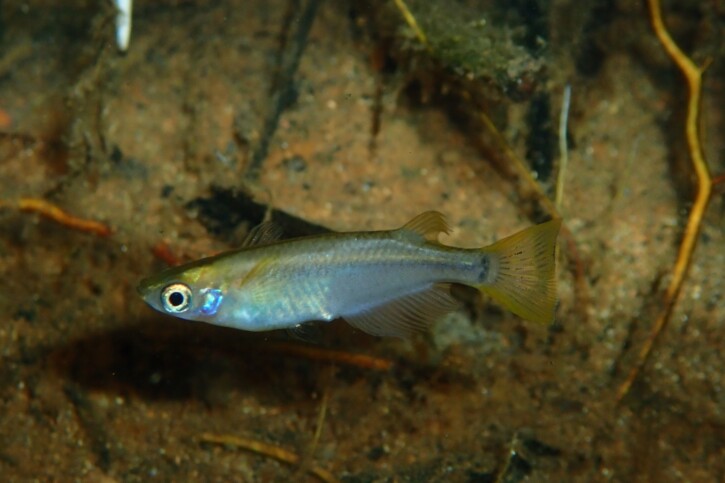
Oryzias latipes is elongated and slender, typical of surface-dwelling fish. The back has a light brown to greenish-gray hue, while the sides fade to a silvery white belly. The fins, usually transparent, may have slight yellowish hues. The small mouth, oriented upwards, indicates adaptation for capturing prey at the surface.
Sexual dimorphism
A subtle sexual dimorphism distinguishes the sexes: males have a small notch on the front part of the anal fin and sometimes display slightly more developed fins, while females have a more rounded abdomen during the breeding season.
Behaviour & Life cycle
-
dietomnivorous
-
Sociabilitygregarious
-
territorialYes
-
Way of livingdiurnal
This gregarious species frequents calm waters in small groups, preferring the surface and upper water column. Its activity is mainly diurnal. Omnivorous, it feeds on small invertebrates, zooplankton, insect larvae, and plant debris, picking them off the surface or among vegetation without active hunting behavior. Cohabitation with conspecifics is peaceful, with aggression being rare outside of the breeding context.
Reproduction
-
Reproductionovipare qui dépose ses Œufs dans la végétation
The reproduction of Oryzias latipes follows a precise cycle linked to the nycthemeral rhythm. Oocyte maturation occurs during the night, followed by ovulation at dawn. Fertilization is external but immediate: the male releases his milt near the female, and the gametes meet upon egg emission. A notable feature of this species is the female's post-spawning behavior: she retains the fertilized eggs, attached to her anal fin by fine filaments, for several hours, or even the entire day. This temporary carrying likely aids in better oxygenation and initial protection. The female then deposits her eggs by rubbing her abdomen against aquatic vegetation or other suitable substrate. No parental care is observed after egg attachment.
Harmless species
This species is harmless to humans.
Origin and distribution
Geographic distribution & Conservation
The native distribution range of Oryzias latipes covers the entire Japanese archipelago, from Honshu Island in the north to the Ryukyu Islands in the south, with the species naturally absent from Hokkaido due to climate. It inhabits the plains and coastal areas of these islands, occupying a wide variety of aquatic environments. While the species is not globally threatened, habitat fragmentation and the introduction of competing species have caused a significant decline in its populations in certain areas, necessitating local conservation measures.
Conservation status of populations (IUCN)
Where to see this species?

What is its habitat?
Natural environment characteristics
-
Temperature18 - 24 °C
-
pH (acidity)7 - 8
-
gh (hardness)9 - 19
-
FlowSlow and Stagnant
Biotope presentation
Oryzias latipes resides in shallow, stagnant waters or very low-flowing currents, rich in aquatic and riparian vegetation. These environments, often characterized by muddy or sandy bottoms, include ponds, marshes, flooded rice paddies, and small slow-moving streams. The species also frequents brackish waters and coastal pools. It has a high tolerance to salinity variations.


To go further
To read on the web

Sources & Contributions
Participation & Validation
The Fishipedia team and specialist contributors are committed to providing high-quality content. However, although the information comes from scientific sources or testimonials from specialists, the cards may contain inaccuracies.

Benoit Chartrer
Translation
Translation done with the valuable contribution of our translators, who make this information available to a wider audience. We sincerely thank them for their commitment.
Where to see this species?
Scientific partners



Tags


