Ascarosepion mestus
- Sepia mestus
- Sepia mestus
| Family | Sepiidae |
|---|---|
| Genus | Ascarosepion |
| IUCN category (World) | LC |

Introduction
Sepia mestus is a salt water mollusc.
This sheet is currently being prepared. The texts currently proposed come from our data model or are being drafted. To request priority for this content, you can write to us HERE.
Who is it?
Morphology
-
Size8 - 12 cm
-
Colourschanging
-
Mimicrymultiple
-
ChromatophoresYes
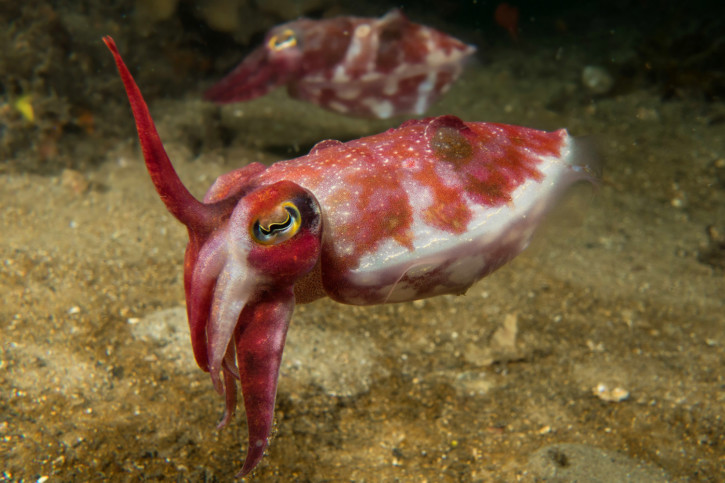
-
Size8 - 12 cm
-
Colourschanging
-
Mimicrymultiple
-
ChromatophoresYes
How to recognize This mollusc ?
Ascarosepion mestus measures between 8 and 12 cm.
Behaviour & Life cycle
-
Sociabilitysolitary
-
Way of livingnocturnal
-
VenomousNo
-
Dietpredator
Chromatophores are pigment cells that reflect light in the integument of some animals. They are mostly responsible for the color of the skin and eyes of cold-blooded animals and are created by the neural crest during embryonic development.
Ascarosepion mestus is a mollusc solitary. This species is carnivorous . This mollusc lives mainly at night. Usually, it leaves its hiding place and starts to be active once it gets dark.
Although Ascarosepion mestus is non-territorial, it is sometimes aggressive towards other species.
Reproduction
-
Reproductionovipare qui dépose ses Œufs dans la végétation
Ascarosepion mestus is a mollusc ovipare qui dépose ses Œufs dans la végétation.
Harmless species
This species does not represent any particular threats to humans when encountered in its natural environment.
Origin and distribution
Conservation status of populations (IUCN)
What is its habitat?
Natural environment characteristics
-
Temperature25 - 30 °C
-
Depth0 - 22 m
-
EnvironmentFree benthic
Biotope presentation
Ascarosepion mestus is most often found at a depth between 0m and 22m. However, it is not impossible to find this species at other depths.


Fishkeeping
Not recommended
We do not recommend keeping this species in an aquarium. It has unpredictable needs which, if not met, generate significant stress, potentially leading to a shorter life expectancy, an interruption of its growth or the development of pathogens.
To go further
To read on the web
Sources & Contributions
Participation & Validation
The Fishipedia team and specialist contributors are committed to providing high-quality content. However, although the information comes from scientific sources or testimonials from specialists, the cards may contain inaccuracies.
Translation
Translation done with the valuable contribution of our translators, who make this information available to a wider audience. We sincerely thank them for their commitment.
Bibliographic references
- GBIF — Ascarosepion mestus
- iNaturalist — Ascarosepion mestus
- Cephalopods of the world - Volume 1. Chambered Nautiluses and Sepioids (Nautilidae, Sepiidae, Sepiolidae, Sepiadariidae, Idiosepiidae and Spirulidae) — FAO Fisheries Synopsis —
Scientific partners