
Introduction
Zoogoneticus purhepechus is a small freshwater fish of the Goodeidae family, endemic to the Mexican states of Jalisco and Michoacán. Its historical distribution range covered a vast territory including the lower basin of the Lerma River, Lake Chapala, the Grande de Santiago River, as well as several lagoons (Atotonilco, San Marcos, Zacoalco, Zapotlán, Sayula) and the upper basin of the Ameca River. Today, the species has disappeared from most of these habitats, notably from the Grande de Santiago River and most of the lagoons. Its current distribution is fragmented into several isolated subpopulations with varying conservation statuses: listed as Endangered (EN) in Lake Chapala and the Duero River, Critically Endangered (CR) in the Ameca River and the Sayula Lagoon, and Data Deficient (DD) in the Zapotlán Lagoon where its presence has not been confirmed since 1990. Despite a minimal extent of occurrence of 12,000 km², the species is experiencing a severe decline due to pollution, droughts, and competition with exotic species.
Who is it?
Morphology
-
Average size3.5 cm
-
Maximum size4.1 cm
-
Average size3.5 cm
-
Maximum size4.1 cm
How to recognize This fish ?
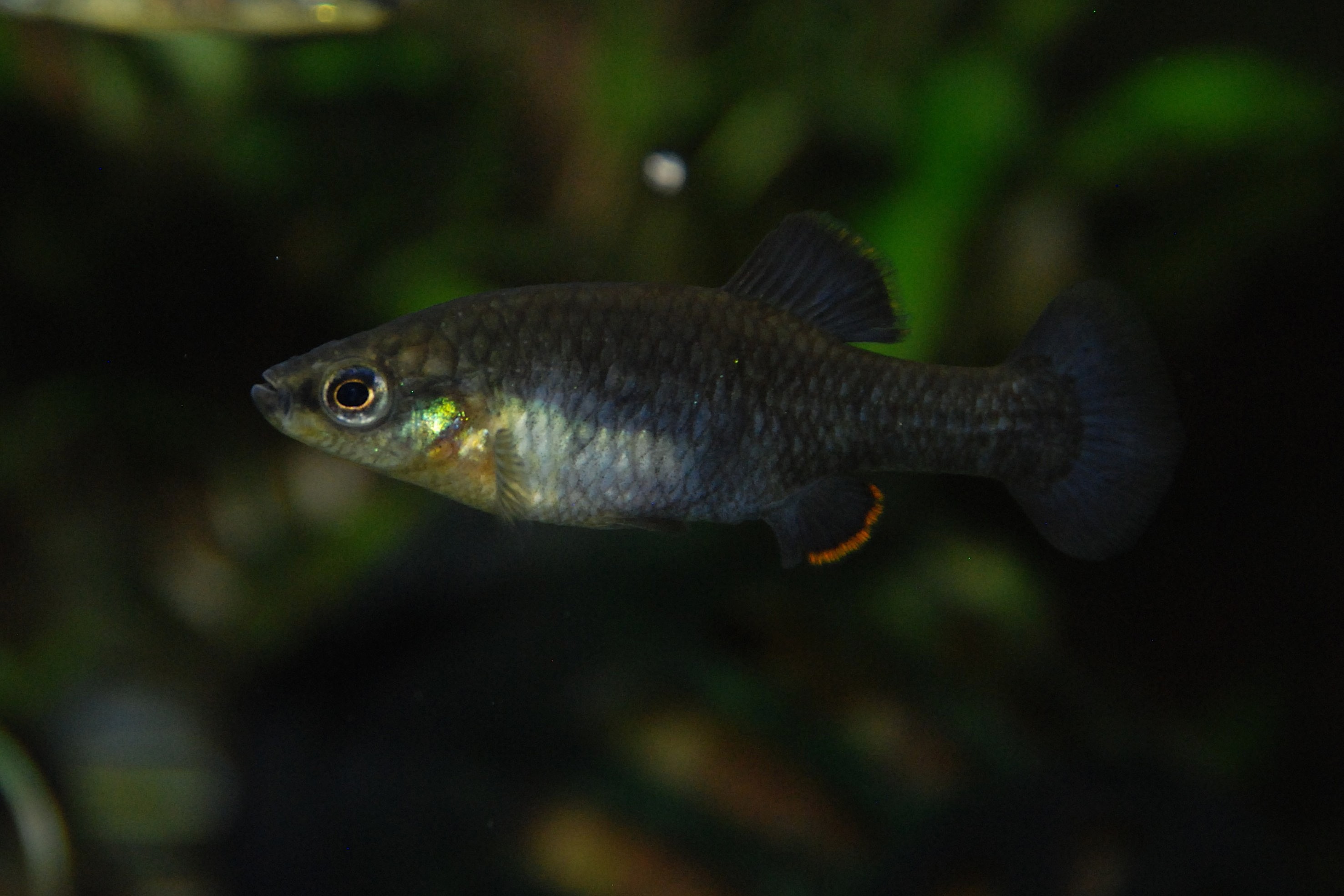
Zoogoneticus purhepechus is slender and laterally compressed, a characteristic of goodeids. This species is distinguished from its sister species Zoogoneticus quitzeoensis by a shorter preorbital distance and a longer base of the dorsal fin, supported by 13 to 14 soft rays.
Both males and females reach a maximum standard length of about 4.1 cm. The coloration ranges from grayish to olive brown, with golden or greenish hues on the flanks. The fins are generally transparent to yellowish. A thin colored edge, often orange or yellow, may rim the fins in healthy specimens.
Sexual dimorphism
Sexual dimorphism is marked by the structure of the anal fin and size. Females are usually larger and more robust than males, especially during gestation. Males are distinguished by their gonopodia (reproductive structures derived from the modification of anal rays) and sometimes by a brighter coloration or slightly more developed fins during courtship.
Behaviour & Life cycle
-
dietcarnivorous
-
Sociabilitygregarious
-
territorialNo
-
Way of livingdiurnal
Zoogoneticus purhepechus is benthopelagic, frequenting both the bottom and the upper water column, usually at a depth of less than one meter (often less than 0.6 m).
It is an active predator that hunts small aquatic invertebrates, foraging in dense vegetation and substrates to capture its prey. The species prefers clear to turbid waters, with a low to moderate current, seeking refuge in dense vegetation areas (green algae, water hyacinths, sedges, pondweeds, water lentils) to escape predators. It shows a strong affinity for structured habitats like reed beds and roots of riparian trees, where it finds food and shelter.
Reproduction
-
Reproductionvivipare
Zoogoneticus purhepechus is viviparous, a distinctive characteristic of its family. Females give birth to fully formed young, capable of swimming and feeding immediately.
This reproductive strategy allows for a rapid replenishment of populations, essential in the face of high mortalities caused by predators targeting fry. Sexual maturity is quickly reached, at around 2.8 cm in length. The species depends on aquatic vegetation for birthing and protection of the newborns.
Harmless species
The species is harmless to humans. Being small and lacking dangerous structures, it poses no risk.
Origin and distribution
Geographic distribution & Conservation
The current distribution is the result of a dramatic decline of its historical populations. In the Grande de Santiago River basin and Lake Chapala, the species survives only in sections of reed beds and adjacent lagoons (such as Los Negritos), threatened by extreme pollution (heavy metals, DDT, wastewater) and competition with introduced sunfish.
In the lower Lerma River, it is restricted to a few dams and tributaries like the Duero River, where agricultural pollution and invasive species (Poecilia, Xiphophorus, Oreochromis) exert constant pressure. The subpopulation in the upper Ameca River, likely limited to the Teuchitlán River and La Vega Dam, is critically endangered due to pollution related to sugarcane production and predation by exotic species. In the Sayula Lagoon, almost dried up by climate change, the species only persists in temporary ponds and ditches. Finally, in the Magdalena Lagoon, the species has almost disappeared from the lake and survives only in isolated springs like Almoloya and La Estancia de Ayones, despite the presence of tilapias and other competitors.
Conservation status of populations (IUCN)
What is its habitat?
Natural environment characteristics
-
Temperature18 - 28 °C
-
pH (acidity)7.2 - 8
-
FlowSlow
Biotope presentation
This fish resides in shallow lakes, ponds, streams, canals, and ditches, on varied substrates ranging from clay and mud to sand, gravel, and rocks. It heavily relies on dense aquatic vegetation that structures its habitat and partially filters pollution. Water quality, although often degraded in its current habitats, remains a major limiting factor.


To go further




Sources & Contributions
Participation & Validation
The Fishipedia team and specialist contributors are committed to providing high-quality content. However, although the information comes from scientific sources or testimonials from specialists, the cards may contain inaccuracies.

Benoit Chartrer
Translation
Translation done with the valuable contribution of our translators, who make this information available to a wider audience. We sincerely thank them for their commitment.
Scientific partners



Tags


